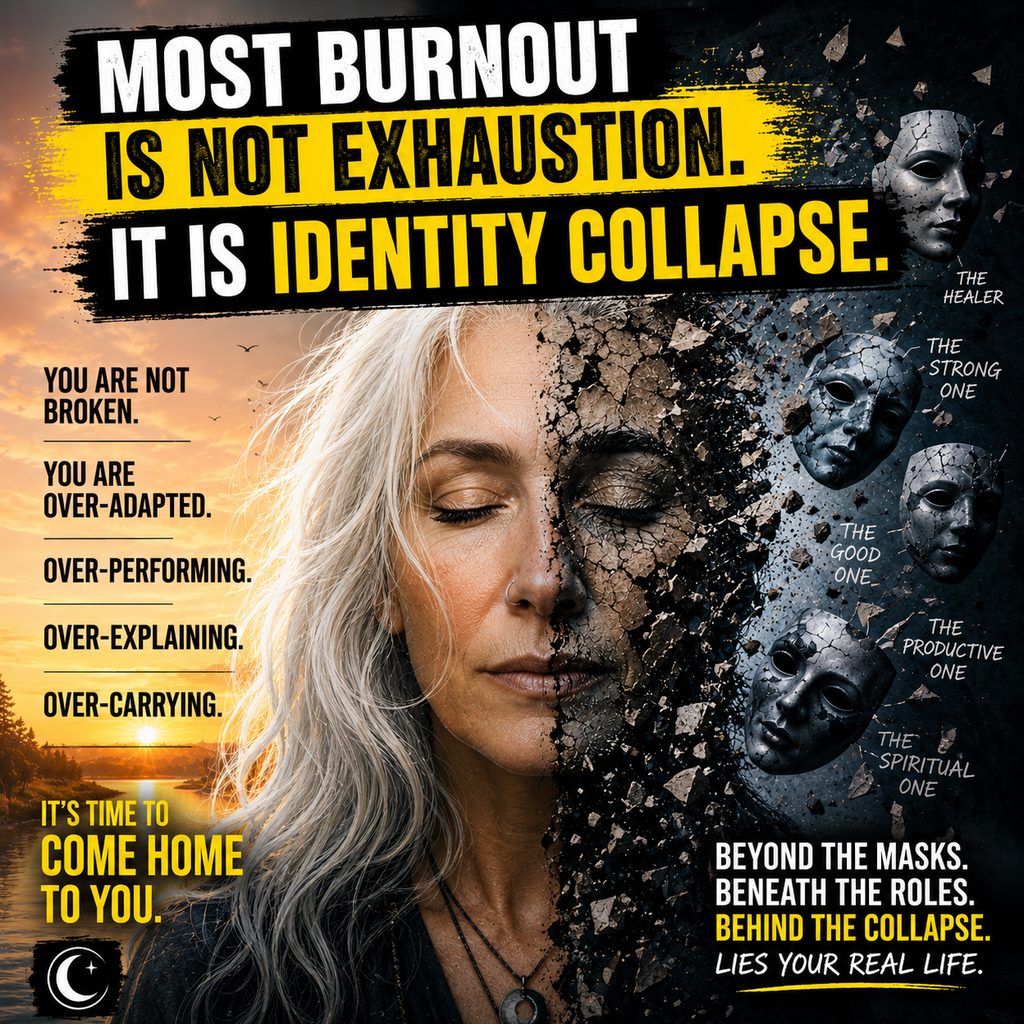
Your Brain Thinks Starting Is Dying (It Is Wrong, But Here’s Why It Does It)

Here is something nobody tells you when they’re encouraging you to begin things.
Your brain, when presented with a genuinely new beginning — not a minor adjustment, not a comfortable next step along a familiar path, but an actual departure from who you have been — experiences something functionally very similar to a threat response. The heart rate changes. The nervous system readies itself. The part of your brain responsible for scanning for danger lights up like a very anxious Christmas tree.
You interpret this as a sign that you shouldn’t do the thing.
It is not a sign that you shouldn’t do the thing. It is a sign that the thing is real.
This distinction is, annoyingly, everything.
What The Brain Is Actually Doing
The neuroscience of identity and change is a relatively young field but it has produced some findings that are, once you understand them, genuinely life-altering in their implications.
Your brain is, at its core, a prediction machine. Its primary function is not experiencing reality — it is building and refining a model of reality that allows it to predict what comes next. This is metabolically efficient. Running predictions off a known model costs far less energy than processing every moment as genuinely new.
Your sense of self — who you are, what you do, how you move through the world — is one of the most sophisticated and energy-intensive predictive models your brain maintains. It is built from everything you have ever experienced, reinforced by every repeated behaviour, shaped by every environment you’ve consistently inhabited.
Weird Facts
Neuroscientist Lisa Feldman Barrett’s work on constructed emotion demonstrates that what we experience as feelings are largely the brain’s best guess about what is happening, based on prior experience rather than direct perception of the body’s signals. The brain is, in her framing, “locked in a dark box” — the skull — receiving only ambiguous electrochemical signals and constructing meaning from them using everything it already knows. This means that a genuinely novel situation is, neurologically speaking, a situation the brain has less data to interpret accurately. The discomfort of beginning something new is partly the brain’s distress at being asked to operate without its usual reference points.
When you contemplate a genuine new beginning — a real one, not a comfortable evolution of what already exists — you are asking your brain to update its model of who you are. That model is not a neutral filing system. It is defended. Departing from it triggers the same neural alarm systems that respond to physical threat because, for the older parts of your brain, departing from the known self is a form of threat. The known self survived. The unknown self is, by definition, unproven.
This is why the feeling of being ready to begin something important often comes with a side order of what feels remarkably like dread.
The Identity Level
NLP — Neuro-Linguistic Programming, for those who aren’t familiar with the territory — has a model of change that maps onto this beautifully. Robert Dilts’ logical levels of change describe a hierarchy: environment, behaviour, capability, beliefs, identity, and above all of those, purpose.
The crucial insight is this: change at a lower level doesn’t necessarily affect higher levels. You can change your environment without changing your beliefs. You can change your behaviour without changing your identity. But change at a higher level always ripples downward.
Chiron in Aries is operating at the identity level. That is why this transit — seven years of it, 2019 to 2027 — has felt so thorough. So foundational. So impossible to shortcut.
The wound Chiron carries through Aries is not about what you do. It is about who you believe yourself to be. Specifically, it is about the places where your self-concept was formed around contraction rather than expansion. Around the belief — usually absorbed very early, often without words — that the full version of you is somehow too much, or not quite enough, or requires justification before it gets to exist.
Weird Facts
Chiron was discovered on 1 November 1977, by astronomer Charles Kowal at Palomar Observatory in California. Kowal described it as “unlike any known asteroid” — it didn’t fit the existing categories. It was eventually classified as a centaur object: something between an asteroid and a comet, belonging fully to neither. This is, if you’re interested in these things, an almost perfect physical metaphor for what the Chiron archetype represents in a chart: the part of you that doesn’t fit the existing categories, that moves between worlds, that belongs to neither the ordinary nor the extraordinary but exists in the uncomfortable and generative space between.
The identity wound in Aries specifically tends to form around visibility. Around being seen. Around whether it is safe — emotionally, relationally, sometimes literally — to be the full and obvious version of yourself rather than the carefully modulated, palatable, takes-up-appropriate-space version.
Many people with significant Chiron in Aries themes in their lives are not, when you observe them closely, actually small people. They are large people who learned, at some point, that their largeness was a problem. Who developed considerable skill in managing their own presence to make others more comfortable. Who can read a room with extraordinary accuracy and adjust accordingly.
The adjustment itself became the wound. Not because managing yourself is wrong. But because it became automatic. Unconscious. The default position rather than a conscious choice.
The Discomfort Is In The Data
Here is where the neuroscience and the Chiron work converge in a way that is worth paying close attention to.
The brain’s alarm response to genuine new beginning? That signal — the one you have been interpreting as stop — is actually information about the level at which the change is occurring.
Small adjustments don’t trigger the alarm. Habit changes are uncomfortable but manageable. But when you feel that particular quality of resistance — the one that doesn’t quite feel like fear and doesn’t quite feel like instinct but sits somewhere in between, heavy and certain and very insistent — that is the signal that you are at the identity level. That you are touching something that will actually change who you are, not just what you do.
The Chiron in Aries transit has been trying to help you distinguish between the resistance that is useful information and the resistance that is your wounded self-concept defending its own existence. Those feel identical from the inside. That is the difficulty.
Weird Facts
The psychological concept of the “window of tolerance” — developed by Daniel Siegel and widely used in trauma-informed therapy — describes the zone of nervous system activation within which a person can process experience effectively. Too little activation and the system goes flat, dissociated, numb. Too much and it floods into fight, flight or freeze. The window of tolerance for identity-level change is genuinely narrow for most people. This isn’t weakness. It is the nervous system doing exactly what it evolved to do. The therapeutic and coaching work of the last several decades has largely been about learning to gently, persistently widen that window — to be able to hold more activation without tipping into shutdown or overwhelm.
The New Moon conjunct Chiron is essentially asking you to be in your window of tolerance and at the edge of it simultaneously. To hold the discomfort of the genuine new beginning without either shutting down or bolting. To let the alarm sound and choose, consciously, to move forward anyway.
This is not about being fearless. Fearlessness is a bit of a red herring. It is about being afraid and doing it anyway, which is a completely different and far more interesting thing.
The Mechanism Of Forward
So what does forward actually look like, when the brain is defending the known self and the wound is active and the discomfort is sitting in your chest like a small but determined stone?
It looks, almost always, like a smaller action than you think it should.
This is one of the places where the grand narrative of transformation collides with the neurological reality of how change actually works. The brain updates its model through repeated, embodied experience. Not through insight. Not through a single pivotal moment of decision. Through doing the new thing enough times, in small enough increments, that the nervous system begins to build a new prediction model from the actual data of having survived it.
The Aries stellium, the zero retrogrades, the Mars trine Pluto — all of this is fire and forward motion and initiation energy. And all of it will be most effectively worked not through one enormous transformative gesture but through a consistent series of smaller ones that gradually shift what your nervous system believes is possible for you.
One conversation you’ve been not having. One thing made, sent, offered, instead of kept. One morning spent on the work that matters instead of the work that’s safe.
The wound heals in the doing. Chiron, in the mythology, was the teacher of heroes — not because he had resolved his own wound, but because he kept teaching anyway. The medicine and the injury existed in the same place.
That is the model. Not healed and then beginning. Beginning, and healing as you go.
A NOTE ON THE WORD READY
There is no neurological state called ready.
There is comfortable, which is the state of operating within the known self-concept without significant threat to the predictive model. And there is the activation that comes with genuine new territory, which feels like its opposite.
You have been waiting to feel the first thing before you do the second thing.
You will be waiting a while.
The Chiron in Aries work — the seven-year, bone-deep, identity-level restructuring of how you show up in the world — has been preparing you not to feel ready, but to move without needing to. To trust the instinct that knows what you want before the conscious mind has finished arguing about whether you deserve it.
That is the medicine. That is the wound and the healing occupying the same space.
The beginning is the cure.
It is amazing what you learn after a stroke.